
Playing Scared
What the Men's U.S. Football Team (& THAT Red Card) Taught Me About Leadership

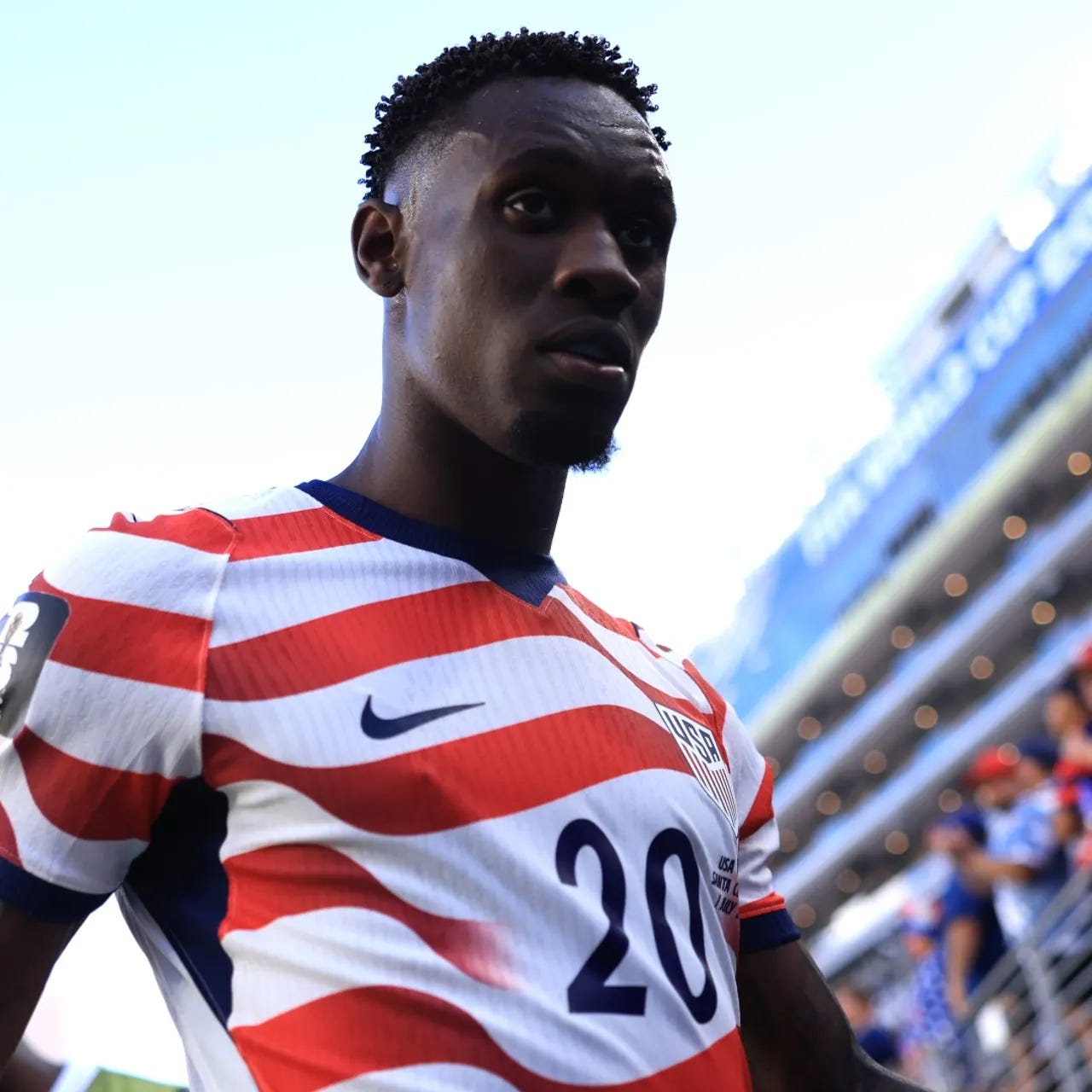
The story started, as so many sporting dramas do, with a split-second decision.
July 1st, 2026.
It’s the 64th minute of the round 32 match of the FIFA World Cup, 2026. The USA are playing Bosnia and Herzegovina. In this moment, American player Folarin Balogun inadvertently stepped on the leg of a Bosnian player. The step triggered a red card.
And, that red card triggered an automatic one-match suspension for the player's next game (fun fact: when it comes to red cards, the FIFA Disciplinary Committee can add further bans for severe offenses like violent conduct).
Beyond the suspension, the red card triggered a tsunami of commentary, heartbreak, speculation, and conversation that divided fans, commentators, podcasters, ex-soccer legends, newbie fans, and athletes from different codes alike.
To be completely transparent, I am sports mad. But, my sports growing up were basketball, baseball, track & field, tennis, swimming… basically everything except for the soccer.
But, having married into the soccer recently, I’ve been passionately watching this World Cup. The nerd in me was amazed to notice that I was having multiple conversations daily with colleagues, friends, and strangers in cafes about the USA red-card incident!
Here’s what I noticed:
Some people believed it was absolute hogwash, harsh, and unwarranted.
Some believed it was the correct decision.
All believed it was a BIG moment.
As always happens with big sporting competitions, millions of people watched the same replay over and over and over again — and many saw something different. The game ended in debates that didn’t end with the final whistle.
THE PLOT (TWIST) THICKENS
In the days that followed the red card, Balogun’s suspension was overturned, allowing him to play in the USA’s next match. That overturning wasn’t unprecedented in itself. Red cards have been rescinded before.
Football’s disciplinary processes have long allowed for reviews in exceptional circumstances when governing bodies determine that an on-field decision warrants reconsideration.
But, the moment was different on all counts.
What made it different wasn’t simply that the red card was overturned. It was everything else that surrounded it.
Public commentary, political attention, and questions about influence quickly became part of the story — and, rightly so. The president of the USA boasted publicly about making a call to the president of FIFA to have the decision overturned. It immediately reeked of Big Brother talking to Big Daddy to sort out an issue that didn’t need or warrant political intervention.
Suddenly, what had begun as a football debate became something much bigger. It became a conversation about fairness, power, and whether leaders should ever use their influence to change the conditions of the game.
Watching it all unfold, I found myself thinking less about football.
And much more about leadership.
STEPPING UP > STEPPING IN
Let’s be real, the most interesting thing about the U.S. Men’s Football team this week wasn’t the red card. It wasn’t even their loss to Belgium in the match where Balogun was reinstated to play.
The most interesting thing was how Team USA looked after all of it. They looked like a team carrying something heavier than expectation. They looked like they were playing scared.
Now, before every football fan reading this starts furiously typing, let me be clear: I’m not writing about refereeing decisions. And, my heart goes out to the USA men’s team because they were disempowered in the situation to a huge extent.
In this moment, I’m no thinking like Sporty Spice.
I’m thinking like a businesswoman.
And, I’m writing about leadership.
Because somewhere between a controversial red card, a powerful intervention, and ninety minutes of football, I found myself thinking about things we rarely talk about in the open.
Things like:
What is the role of a leader when the people they’re responsible for encounter adversity?
Is it to remove it?
Or is it to help people become capable of facing it?
These two things are not the same.
And I think we confuse them far more often than we’d like to admit.
LEADERSHIP HAS AN IMAGE PROBLEM
We’ve romanticised the hero.
The leader who storms in.
Fixes everything.
Pulls strings.
Makes the phone call.
Changes the outcome.
We applaud decisive action. We celebrate influence. We reward the person who “gets things done.” But somewhere along the way, we’ve mistaken intervention for leadership.
Sometimes, they’re worlds apart.
Because every time a leader uses their power to remove an obstacle for someone else, they’re making a trade.
Sometimes it’s the right trade. Sometimes it isn’t. The question isn’t whether you can change the circumstances. It’s whether changing them actually helps the people you’re leading.
SPORT REMEMBERS WHAT LEADERS OFTEN FORGET
Sport has always understood something that leadership occasionally forgets.
Pressure isn’t the enemy.
It’s the training ground.
Nobody becomes mentally stronger because every referee gets every decision right. Nobody develops resilience because every game goes their way. Nobody discovers confidence because someone more powerful keeps changing the conditions.
Confidence grows through evidence —> evidence grows through experience —> experience almost always involves discomfort.
If you’ve spent time around elite athletes, you’ll know this instinctively. The best coaches don’t spend their energy trying to convince officials to rewrite the game.
They spend their energy preparing athletes to win anyway.
To recover.
To adapt.
To regulate.
To solve problems under pressure.
Because the goal isn’t to create easier conditions.
It’s to create stronger competitors.
Far too often, the fundamentals of leadership, teamwork, and coaching in sport are forgotten beyond sport.
WE DON’T NEED ANOTHER HERO
Rescuing that’s confused for development shows up in so many moments.
Moments like…
A manager who solves every problem instead of coaching their team through it.
A parent who removes every obstacle before their child has the chance to stumble.
A CEO who silences disagreement instead of building cultures where people can navigate conflict well.
A politician who believes influence is measured by how often they can alter the playing field.
Power is seductive. Not because it allows us to control outcomes. Because it convinces us we’re helping when we’re actually preventing growth.
Which brings me to a truthy truth: Sometimes the hardest thing a leader can do is nothing.
Not because they don’t care.
Because they trust.
They trust that the people they’ve invested in are capable of meeting the moment.
Watching the United States play, I couldn’t help wondering whether the story surrounding the team had become bigger than the game itself.
Whether the players were no longer simply trying to beat Belgium. Whether they were trying to justify everything that had happened beforehand.
That’s a heavy thing to carry.
But it reminded me of something I see in organisations every day. People perform best when they don’t have to carry someone else’s agenda.
When they don’t feel indebted. When they aren’t trying to prove that the intervention was worth it. When they simply get to play.
Great leadership creates those conditions.
It doesn’t become the headline.
RULES MATTER
There’s another lesson hidden in all of this.
Rules matter.
Not because they’re always perfect. Anyone who has watched enough sport knows officials get things wrong. Life gets things wrong. Systems get things wrong.
Sometimes they deserve to be challenged.
Sometimes they need changing.
History is full of courageous people who challenged unfair rules and changed the world for the better. But that’s different from changing the rules because they’re inconvenient for your side.
Leadership isn’t about ensuring your team never experiences unfairness. Leadership is about helping your team respond to unfairness with courage, composure, and belief.
Because that’s what lasts.
The greatest leaders I’ve known rarely tried to make life easier.
They made people stronger.
They create environments where mistakes become learning. Where setbacks become stories. Where pressure becomes possibility. Where people trust themselves enough to know they don’t need rescuing.
That kind of confidence can’t be gifted.
It has to be grown.
I think that’s the leadership lesson hiding inside this football story.
The best leaders don’t move the goalposts.
They prepare people to score anyway.
They don’t rewrite the rules every time life becomes uncomfortable.
They build humans who can navigate discomfort with courage.
Because confidence built on exceptions disappears the moment the exception does.
But confidence built through experience?
That stays with you long after the final whistle.
And if we’re trying to build people—not just win moments—that seems like the better game to play.
What do you reckon?
For me its kudos for the Belgian team in using this farce to motivate themselves to play the best 90 minutes they could. I wonder if we will ever hear how the US team felt. I would hazard a guess that they were carrying a lot of unfair weight on their shoulders that they didn't ask for. It might have been even worse if they had won and Balogun scored a goal? Guess who would have taken credit for making that possible. If anything, I think the USA team would have had a much better chance if the call to Infantino never happened.
I'm an idealist. One of the concepts I love about the history of the Olympics, is that countries could be at war with each other, but then could safely compete in sport against each other, before going back to war. I know this wasn't always the case, but I loved the principle. Iran is an example in the current World Cup. Their opportunity to play in the World Cup exemplifies keeping a distance between politics and sport.
There is more than enough politics in football as it is, particularly the money involved, which is the nature of the world we live in. But this example to me is two people who have egos bigger than Jupiter, especially when it comes to their ability to "make deals", showing that if you have enough money and power, you can pretty much do what you like and the rest of the world should just accept that.
As Orwell said, "Some animals are more equal than others." Or as Mr President said, "I did it." and "I didn't think it was a foul. I'm good at this stuff."